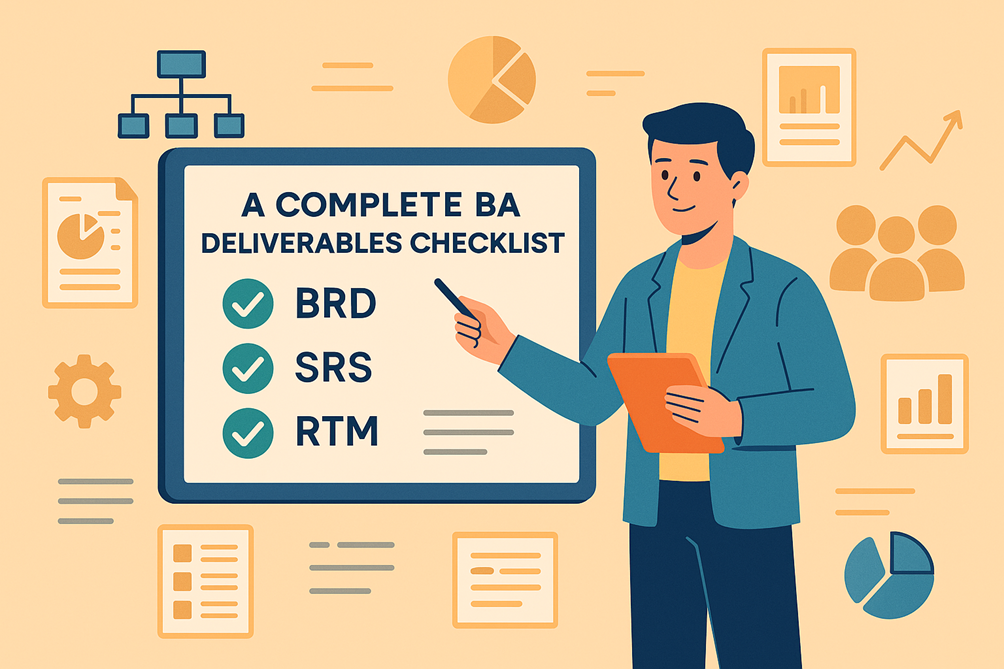
“A complete BA deliverables checklist: BRD, SRS, RTM, and more — learn definitions, benefits, steps, tools, and best practices to ensure project success
✨ Introduction: Why BA Deliverables Define Project Success
Ever been in a project where nobody knows which document is the latest version or key requirements got lost?
That’s where a well-defined set of BA deliverables saves the day.
A Business Analyst’s deliverables act as the blueprint, roadmap, and contract between stakeholders and delivery teams.
Whether it’s a Business Requirements Document (BRD), a System Requirements Specification (SRS), or a Requirements Traceability Matrix (RTM), each artifact plays a critical role in avoiding confusion, managing scope, and ensuring successful delivery.
In this guide, we’ll cover:
- Core BA deliverables and their purpose
- Benefits of maintaining a deliverables checklist
- Step-by-step approach to creating each key document
- Future trends like AI-assisted documentation
📝 Section 1: What Are BA Deliverables?
BA deliverables are the documents, diagrams, and visual assets a Business Analyst creates to:
- Capture business needs and solutions
- Align stakeholders, developers, and testers
- Track requirements across the Software Development Life Cycle (SDLC)
👉 In short: Deliverables translate ideas into structured, actionable insights.
🌟 Section 2: Why a Deliverables Checklist Matters
| Benefit | Why It’s Important |
| Consistency | Ensures all projects follow a standard documentation process |
| Transparency | Keeps stakeholders informed about progress |
| Traceability | Tracks requirements from idea to implementation |
| Compliance & Audit Readiness | Essential for regulated industries like Finance & Healthcare |
| Reduced Rework | Clear documents prevent scope misunderstandings |
🔎 Section 3: The Complete BA Deliverables Checklist
Here’s a comprehensive list of key deliverables, grouped by project phases:
1. Initiation Phase
- Project Vision Document: Describes the purpose, scope, and goals.
- Stakeholder Register: Identifies key players and their roles.
- Business Case: Justifies the investment in the project
2. Requirements Phase
- Business Requirements Document (BRD): Captures what the business needs.
- Stakeholder Analysis Matrix: Shows influence, interest, and engagement levels.
- Requirements Elicitation Notes: Summaries from interviews and workshops.
- Process Maps & Workflows: Often modelled with BPMN diagrams
3. Analysis & Design Phase
- Functional Requirements Document (FRD): Explains how the solution will meet BRD needs.
- System Requirements Specification (SRS): Defines functional & non-functional system specs.
- Use-Case Diagrams (UML): Visualize user interactions with the system.
- Wireframes & Mockups: Demonstrate user interfaces.
- Data Flow Diagrams (DFD): Show how data moves across systems.
4. Traceability & Validation Phase
- Requirements Traceability Matrix (RTM): Links each requirement to test cases and delivery status.
- Gap Analysis Document: Highlights what’s missing compared to current processes.
- Acceptance Criteria Checklist: Defines measurable conditions for requirement approval.
5. Testing & Delivery Phase
- User Acceptance Test (UAT) Plan & Scripts: Ensures business validation before release.
- Change Request Log: Tracks approved changes with their impact on scope/timeline.
- Transition Plan: Supports handover to operations or support teams.
6. Post-Implementation
- Lessons Learned Report: Captures insights for future projects.
- Post-Project Review Document: Measures project outcomes against objectives
🔥 Section 4: Spotlight on Key BA Deliverables
📂 1. Business Requirements Document (BRD)
Defines business needs, scope, and objectives.
Acts as a contract between business stakeholders and delivery teams.
👉 Key Sections: Executive Summary, Business Goals, High-Level Requirements, Scope & Out of Scope.
📄 2. Functional Requirements Document (FRD)
Details specific solution features, rules, and workflows derived from the BRD.
👉 Example: “System must generate invoice PDFs automatically after checkout.”
🖥️ 3. System Requirements Specification (SRS)
Bridges business needs and technical implementation, specifying:
- Functional requirements
- Non-functional requirements (e.g., performance, security)
- Integration details.
🔗 4. Requirements Traceability Matrix (RTM)
Ensures every requirement is implemented and validated.
Tracks requirement ID → linked test case → deployment status
🗺️ 5. Process Maps & Workflows
Visual diagrams (like BPMN swimlanes) that illustrate the end-to-end business process.
🎨 6. Wireframes & Mockups
Provide visual context for user interfaces, improving understanding of requirements.
🪜 Section 5: Steps to Create and Manage BA Deliverables
Step 1: Understand Project Scope & Goals
- Align with business sponsors and project managers.
Step 2: Identify Required Deliverables
- Choose based on methodology (Waterfall vs Agile) and regulatory needs.
Step 3: Use Templates for Consistency
- Standardize formats for BRD, SRS, RTM to save time.
Step 4: Collaborate with Stakeholders
- Co-create diagrams, workflows, and wireframes during workshops.
Step 5: Version Control & Documentation
- Use tools like Confluence, SharePoint, or Jira to manage document versions.
Step 6: Review & Approve Validate deliverables with stakeholders and sign-offs at each phase
🌍 Section 6: Tools for BA Deliverables
| Deliverable Type | Recommended Tools |
| BRD, FRD, SRS | MS Word, Confluence, Google Docs |
| RTM | Excel, Smartsheet, Jira + Zephyr |
| Process Maps & Workflows | Lucidchart, Visio, Draw.io |
| Wireframes | Balsamiq, Figma, Adobe XD |
| Collaboration & Storage | SharePoint, Notion, Confluence |
⚙️ Section 7: Best Practices for BA Deliverables
- ✅ Start with a deliverables checklist for each project
- ✅ Maintain traceability links across documents
- ✅ Keep visual artifacts (diagrams, workflows) simple and clear
- ✅ Review frequently with stakeholders to prevent gaps
- ✅ Automate updates where possible to save time
🚧 Section 8: Common Mistakes to Avoid
| Mistake | Impact |
| Skipping stakeholder reviews | Leads to missed requirements |
| Creating overly detailed documents too early | Causes delays and confusion |
| Not updating RTM during scope changes | Leads to defects and testing failures |
| Storing deliverables across multiple platforms | Causes version conflicts and lost data |
🔮 Section 9: Future Trends in BA Deliverables
- AI-powered documentation assistants to auto-generate drafts from workshops
- Integrated dashboards connecting BRDs to live project KPIs
- Real-time collaborative diagrams for hybrid and remote teams
- Blockchain-backed document verification for compliance-heavy industries
🏆 Section 10: Quick BA Deliverables Checklist
✅ Project Vision Document
✅ Stakeholder Register
✅ BRD → FRD → SRS
✅ Process Maps & Workflows
✅ RTM → Gap Analysis → UAT Scripts
✅ Change Request Log → Transition Plan
✅ Lessons Learned & Post-Project Review
🏁 Key Takeaways
- BA deliverables are the backbone of successful projects.
- A checklist approach reduces risks and improves collaboration.
- Combining clear documentation with modern tools makes BA work faster, easier, and more transparent
💬 Conclusion: Deliverables that Drive Clarity and Success
Strong BA deliverables aren’t just paperwork — they’re communication tools that align everyone on what needs to be built and how success will be measured. 👉 Whether you’re a new BA or a seasoned pro, following a structured deliverables checklist will help you ensure quality, compliance, and stakeholder confidence in every project
💡 Call to Action
Download this checklist and start using it in your next project kickoff meeting — your future self will thank you.